
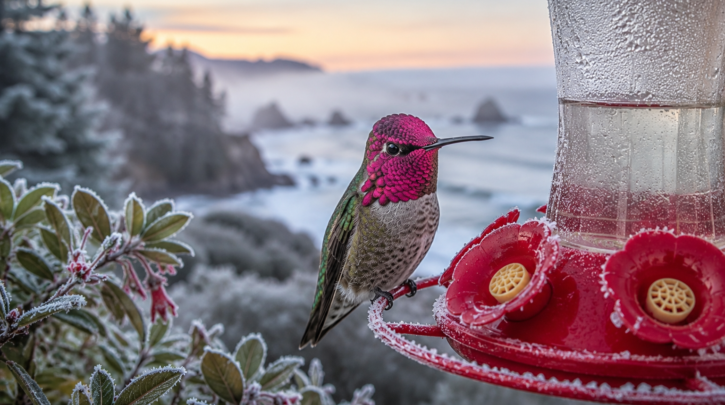

Most of North America has no hummingbirds at all in winter, but two real exceptions make this a genuinely relevant season in specific regions: Anna’s hummingbirds that stay resident along much of the Pacific Coast, and occasional western-species strays that turn up unexpectedly in the Southeast.
Anna’s Hummingbirds Along the Pacific Coast
Unlike most North American species, Anna’s hummingbirds commonly remain resident through winter across much of coastal California, Oregon, and Washington rather than migrating south. This means a well-maintained winter feeder in that range is providing genuine year-round support to a resident population, not just an off-season gesture with no real audience.
Freeze Protection for Feeders
Nectar freezes at a lower temperature than plain water but will still solidify in a hard freeze, making the feeder unusable exactly when a resident bird needs it most. Bringing a feeder inside overnight and putting it back out at first light is the simplest fix; heated feeder bases and pipe-insulation wraps with a low-wattage heat source are also available for anyone dealing with regular freezing temperatures through the winter rather than occasional cold snaps.
Winter Torpor Runs Deeper
Torpor — the nightly metabolic slowdown covered in our lifespan guide — becomes even more critical for birds actually enduring winter cold rather than a mild summer night. A resident Anna’s hummingbird surviving a freezing night is leaning heavily on that metabolic drop, which makes a reliable, unfrozen food source the next morning genuinely important rather than a nice-to-have.
Winter Vagrants in the Southeast
Since the 1990s, birders and researchers have documented a real pattern of western hummingbird species — rufous most commonly, along with occasional black-chinned, calliope, and others — turning up at feeders in the southeastern US during winter months, well outside their normal range. The cause isn’t fully settled, but reliable backyard feeders may play a role in supporting these birds through an unplanned winter stay far from their usual wintering grounds.
What to Do If You See a Winter Hummingbird
A hummingbird at a feeder in the Southeast in December or January is worth reporting to a local birding group or citizen-science network, since these sightings contribute to genuine, ongoing research into the pattern. In the meantime, keeping the feeder clean and stocked through the encounter — with the same freeze protection covered above — gives an out-of-range bird its best shot at getting through the winter safely.
Should You Keep a Feeder Up All Winter Just in Case
Outside the Pacific Coast’s resident Anna’s range and the Southeast’s documented vagrant pattern, a winter feeder in most of the US and Canada genuinely won’t see hummingbird traffic, since there’s no wintering population left to visit it. It’s not harmful to leave one up regardless, but the practical move for most of the country is following the guidance in our fall guide and storing the feeder once local migrants have clearly moved on.
Winter Camera Feeders Add Real Value
For anyone in an overwintering or vagrant-prone region, a camera feeder is particularly useful in winter specifically, since an unexpected visitor is exactly the kind of sighting worth documenting and reporting accurately rather than relying on a brief glimpse through a cold window. See our camera feeder guide for models with reliable cold-weather performance.
A Simple Winter Checklist
- Pacific Coast residents: keep feeders up and freeze-protected all winter for resident Anna’s hummingbirds
- Southeast residents: watch for out-of-range winter visitors and report any sightings
- Everywhere else: clean, dry, and store the feeder once fall migration has clearly wrapped up
- Bring feeders in overnight during hard freezes wherever birds are still present
Winter Is the Quietest Season for Most Readers — And That’s Fine
For the large majority of this site’s readers outside the Pacific Coast and the Southeast, winter is genuinely a hummingbird-free season, and that’s a normal, expected part of the yearly cycle rather than something to work around. The productive use of this quieter stretch is planning ahead — reviewing what worked in the plant guide this past year, researching gear upgrades, and getting ready for the spring arrivals covered in our spring guide — rather than expecting activity that isn’t coming.
The birds will be back on schedule regardless — winter downtime doesn’t change spring’s arrival timing one way or the other.