
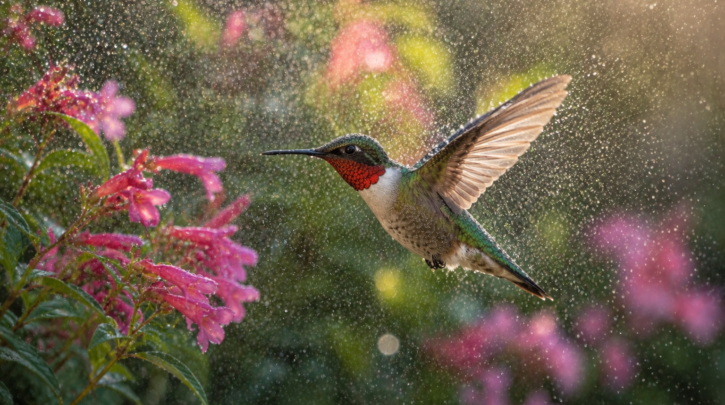

A standard bird bath basin, the kind that works well for robins and jays, usually doesn’t do much for hummingbirds. Their preferred way to bathe is flying directly through a fine mist or rubbing against wet leaves, rather than wading into standing water — which changes what “the best bird bath” actually means for this species specifically.
Why Standard Basins Underperform for Hummingbirds
Hummingbirds are light enough, and their legs proportionally small enough, that perching at the edge of a basin and wading in the way larger birds do isn’t a comfortable or natural behavior for them. Where a basin does get used is incidentally, by other backyard birds sharing the same yard, so it’s not a wasted purchase — it just isn’t the feature that specifically draws hummingbirds in the way people often expect.
Misters Are the Real Draw
A fine mister, either a dedicated hummingbird mister or a garden mister attachment aimed near flowers or a bath’s edge, is what actually gets hummingbirds bathing. They’ll fly directly through the mist repeatedly, and often follow up by rubbing against nearby wet leaves to work moisture into their feathers — both behaviors are much closer to how they interact with rain or dew in the wild than anything involving standing water.
Drippers as a Middle Ground
A dripper, which releases a slow, steady drip into a basin below, attracts a wider range of species than a mister alone since the sound and motion of dripping water is broadly appealing to birds generally, hummingbirds included to a lesser degree than dedicated misting. A combination unit — dripper into a basin plus a separate leaf mister nearby — covers both the general backyard-bird audience and the hummingbird-specific preference in one setup.
Setting Up a Mister
Most misting attachments connect to an outdoor spigot via standard garden hose fittings and can be staked into the ground, hung from a branch, or mounted near a feeder. Positioning it close to existing flower plantings or a feeder gives hummingbirds a reason to already be in the area; see our plant guide for species that pair well with a nearby mister setup.
Water Safety and Mosquito Prevention
Standing water that isn’t kept moving or regularly changed becomes a mosquito breeding site within days, so any basin used alongside a mister or dripper needs either continuous water movement or a cleaning schedule at least every few days. Keeping the water shallow — an inch or two at most in any section a small bird might use — also matters for safety, since bird baths designed for larger species can be too deep for something as small as a hummingbird to use safely even incidentally.
Winter Considerations
In regions where hummingbirds overwinter, like much of the Pacific Coast where Anna’s hummingbirds stay resident, a mister or dripper that can handle near-freezing temperatures without cracking becomes relevant in a way it isn’t for a purely seasonal, summer-only setup elsewhere in the country. A freeze-resistant design or simply disconnecting and draining the system before hard freezes prevents the kind of cracked tubing that turns into a spring repair job.
Placement Relative to Feeders
Positioning a mister within sight of a nectar feeder, but not directly on top of it, tends to work well — close enough that a bird already visiting the feeder notices the mist, far enough that dripping water doesn’t end up diluting or contaminating the nectar reservoir itself. See our feeder guide for placement considerations that apply to both features together in the same general area of a yard.
Solar and Battery-Powered Options
For yards without a convenient outdoor spigot, battery or solar-powered misting and water-agitator products exist as an alternative to a hose-fed system, though they generally produce a gentler effect than a pressurized mister. These work reasonably well for the water-agitation and mosquito-prevention side of things, but tend to be a weaker draw specifically for hummingbird mist-bathing behavior compared to a proper fine-mist attachment on real water pressure.
The Bottom Line
If the goal is specifically attracting hummingbirds, a fine mister or leaf mister is the higher-impact purchase over a standard basin bath. If the yard already hosts a broader mix of backyard birds, a combination setup — basin plus dripper, with a separate mister nearby — covers the widest range of species and behaviors without needing to choose one approach over the other.
Either way, moving water of some kind consistently outperforms a still basin alone for drawing hummingbirds specifically.