
Hummingbirds occupy a wider range of habitats than most people assume — desert edges, mountain meadows above 10,000 feet, dense eastern woodland, and ordinary suburban backyards all support breeding populations depending on species. What ties these together isn’t a specific landscape type but a consistent set of resources: nectar, insects, water, and safe perching and nesting cover, in whatever combination a given environment can provide.
Woodland Edges and Forest Understory
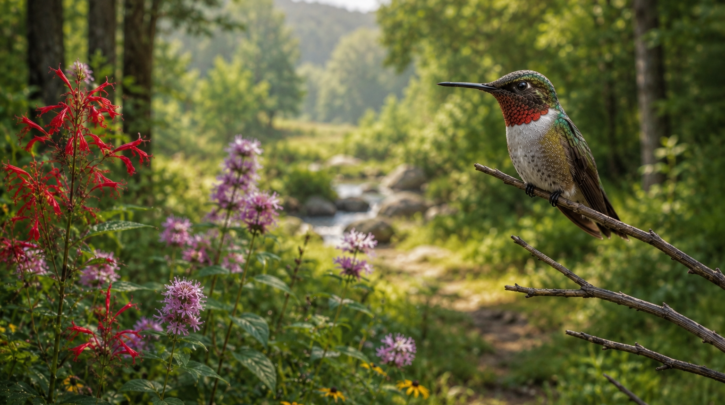
Ruby-throated hummingbirds, the only species breeding across most of the eastern US and Canada, favor the edges of deciduous woodland rather than deep forest interior — the transition zones where sunlight reaches flowering plants but tree cover still offers nesting sites and shelter. Suburban yards backing onto woodland edges often perform better for hummingbirds than either open lawn or dense unbroken forest, since they combine both flower access and cover in one space.
Desert and Arid Habitats
Species like Costa’s and Anna’s hummingbirds thrive in desert and chaparral habitat across the Southwest, timing their breeding to match the bloom of desert-adapted plants like ocotillo and agave after seasonal rains. Water is scarcer in these habitats, which makes even a small water feature disproportionately valuable to local hummingbirds compared to a wetter climate where standing water is already common.
Mountain Meadows and High Elevation
Broad-tailed and rufous hummingbirds breed at elevations up to 10,000 feet or higher in the Rockies and Cascades, using alpine and subalpine meadows thick with wildflowers during the short mountain summer. These populations compress their entire nesting cycle into a narrower window than lowland species, since the growing season at altitude is considerably shorter.
Urban and Suburban Yards
Hummingbirds adapt to human landscapes more readily than many other bird groups, in part because a small planted area or a single feeder can supply a meaningful share of what one bird needs. This makes backyard habitat genuinely consequential rather than symbolic — unlike species that need large unbroken tracts of native habitat, a single well-planted yard or balcony can function as real habitat for a hummingbird passing through or nesting nearby.
The Four Things Any Habitat Needs to Provide
- Nectar — from flowers, feeders, or both; see our feeding guide for what actually works
- Insects — the protein source that nectar alone can’t provide, especially during nesting season
- Water — a fine mister or dripper is often used more than standing water, which hummingbirds tend to avoid bathing in directly
- Cover — thin bare twigs for perching and resting, plus denser branches for nesting and shelter from weather
Perching Matters More Than People Expect
Despite the image of a hummingbird in constant flight, they actually spend a large majority of their time perched rather than flying, since hovering and active flight burn energy at an extreme rate that can’t be sustained constantly. A habitat with plenty of thin, exposed perches near feeding areas supports far more resting time — and therefore energy conservation — than one that’s all flowers and no place to sit between visits.
Habitat Loss and Backyard Compensation
Development and agricultural conversion have reduced native hummingbird habitat in many regions, but unlike species that need large contiguous wilderness, hummingbirds respond well to fragmented, human-modified habitat patched together across a neighborhood — one planted yard connecting to the next functions as a usable corridor even when no single yard is very large. This is part of why backyard feeding and planting have a genuinely measurable impact on regional hummingbird populations rather than being purely a personal-enjoyment activity.
Territory Size Within a Habitat
A single hummingbird’s actual feeding territory is surprisingly small — often just a quarter acre or less around a reliable food source, defended aggressively against other hummingbirds. This is why a good habitat doesn’t need to be large to matter; a well-planted quarter acre or even a dense cluster of containers on a patio can function as genuine, complete territory for one bird rather than a token gesture toward a species that needs far more space than a yard could ever provide.
Matching Habitat to Season
What a habitat needs to provide shifts through the year. Early spring arrivals need dependable nectar right after a long migration with little margin for error; midsummer residents need the insect-rich conditions that support nesting; and late-season habitat needs to support the heavy fattening described in our migration guide. A habitat that peaks in one season and goes quiet in another is doing less for local hummingbirds than one planted for a long, staggered bloom window.
Habitat and Species Overlap
In regions where multiple species’ ranges overlap, habitat preference is often the deciding factor in which species actually shows up at a given location even when several are technically present in the area. A yard heavy on desert-adapted plants in the Southwest is more likely to draw Costa’s than a lusher, well-watered garden nearby, even though both species may be present somewhere in the same city — habitat, not just geographic range, shapes who actually visits.