
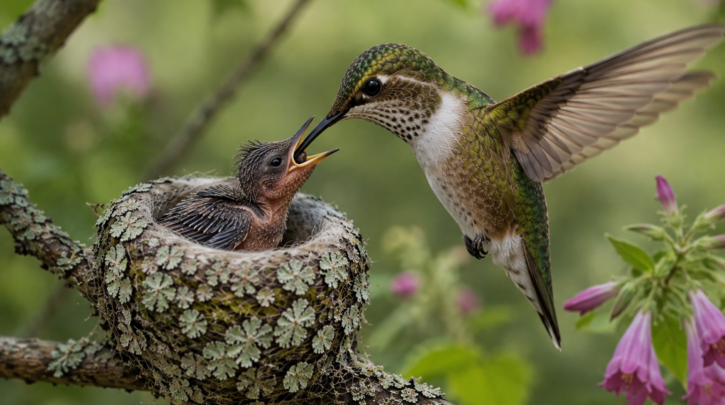

Baby hummingbirds hatch about the size of a bumblebee — blind, featherless, and completely dependent on their mother. What follows is one of the fastest growth periods of any bird: from that bumblebee-sized hatchling to a fully-feathered, flight-capable juvenile in under a month, fueled entirely by a diet the mother has to hunt and gather herself.
What Hatchlings Look Like
Newly hatched hummingbirds are altricial, meaning they’re born in an undeveloped state that requires intensive parental care, unlike ground-nesting birds whose chicks can walk and feed themselves within hours. They have no down or feathers, closed eyes, and weigh a fraction of a gram. At this stage they’re entirely reliant on the nest’s insulation and their mother’s body heat to stay warm, since they can’t yet regulate their own temperature.
How the Mother Feeds Them
Unlike the sipping motion adults use at flowers and feeders, a mother feeds chicks by inserting her long bill directly into the nestling’s throat and regurgitating a mixture of partially digested insects and nectar. This method delivers a concentrated dose of both the protein chicks need to grow tissue and feathers and the sugar they need for fuel, in a single feeding rather than two separate food sources. Feeding trips happen frequently throughout the day, since chicks burn through that energy fast and can’t store much reserve.
Growth Rate
Growth over the first two weeks is dramatic — feathers begin coming in within the first week, eyes open around a week to ten days after hatching, and body size increases many times over before fledging. This rapid pace is only possible because of the protein-heavy insect diet described above; a nectar-only diet wouldn’t supply nearly enough building material for feathers and muscle in that short a window.
Fledging Timeline
Most North American species fledge, meaning the chicks leave the nest under their own power, somewhere between 18 and 28 days after hatching, with exact timing varying by species and how much food was available during development. First flights are short and often clumsy, typically to a nearby branch rather than any real distance, and young birds usually return to or stay near the nest site for several more days as their flight strength builds.
Life After Fledging
Fledglings aren’t fully independent the moment they leave the nest. The mother continues feeding them for roughly one to two additional weeks while they practice flying and start investigating flowers and feeders on their own. During this stretch, young birds are at their most vulnerable — inexperienced fliers with underdeveloped judgment around predators; see our predators guide for what they’re up against at this stage.
What to Do If You Find a Baby Hummingbird
A fully feathered young bird hopping on the ground or perched low nearby is usually a normal fledgling learning to fly, not an animal in distress — the mother is very likely nearby and still feeding it, so the best action is leaving it alone and keeping pets away. A featherless or clearly injured chick found on the ground below a known nest is a different situation, and the safest response is contacting a licensed wildlife rehabilitator rather than attempting to feed or care for it directly — sugar water given incorrectly can cause a chick to aspirate, and rehabbers have the proper formula and equipment for hand-rearing when it’s genuinely needed.
Why Insects Matter So Much at This Stage
The extreme growth rate packed into just a few weeks is only possible because the diet during this window is far more protein-heavy than an adult hummingbird’s typical nectar-dominant diet. A yard with healthy insect populations — meaning no broad-spectrum pesticide use — gives a nesting female a meaningfully easier time keeping up with that demand; see our feeding guide for how insects fit into the diet at every life stage, not just during chick-rearing.
Distinguishing a Fledgling From an Adult Female
A newly fledged juvenile can look confusingly similar to an adult female at a quick glance, since neither shows adult male gorget color. The clearest tells are behavioral: fledglings fly less confidently, spend more time perched than adults, and are often still being actively fed by a parent nearby, which is the single strongest sign you’re looking at a young bird rather than a mature adult.
How Siblings Compare
Because the two eggs in a clutch are often laid a day or two apart, the two chicks can hatch slightly out of sync and show a visible size difference in their first several days. This gap generally closes as both chicks get fed on the same rotation, and by the time feathers come in it’s usually hard to tell which sibling hatched first without having watched the nest from day one.