
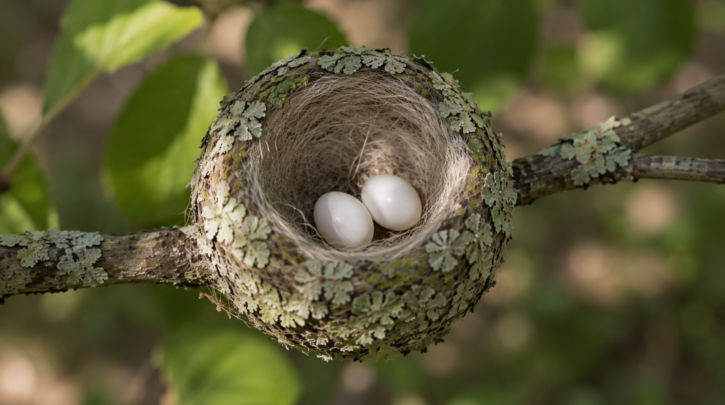

Hummingbird eggs are tiny even relative to the bird laying them — roughly the size of a coffee bean or small jellybean, and among the smallest eggs laid by any bird. A typical clutch is just two eggs, incubated entirely by the female, and the whole process from laying to hatching moves fast compared to most backyard birds.
Size and Appearance
A hummingbird egg is white, oval, and measures roughly 12 to 14 millimeters long — smaller than a standard pea in some species. Despite the tiny size, an egg can weigh a meaningful fraction of the female’s own body weight, which is part of why laying even a two-egg clutch is a significant physical investment and why females need extra protein from insects in the days leading up to laying; see our feeding guide for how that protein need shapes their diet during nesting season.
Clutch Size
Almost all North American hummingbird species lay exactly two eggs per clutch. A single egg or, rarely, three does happen, but two is overwhelmingly the norm across species. This is a smaller clutch than most backyard songbirds lay, and it reflects the sheer physical cost of producing even one hummingbird egg relative to the mother’s tiny body size.
Incubation Time and Process
The female incubates alone, typically for about 12 to 14 days depending on species and weather, periodically leaving to feed and returning to keep the eggs at a stable temperature. Cooler weather can extend incubation slightly, since the female has to spend more time away from the nest maintaining her own energy levels through more frequent feeding trips. There’s no male involvement at any point in this process — incubation, like nest-building, falls entirely to the female.
Hatching
Eggs in a clutch typically hatch within a day of each other, though the second egg is often laid a day or two after the first, which can produce a slight but noticeable size difference between chicks in the first days after hatching. Hatchlings emerge blind, featherless, and entirely dependent — see our baby hummingbird guide for what happens in the weeks immediately after hatching.
What to Do If You Find a Nest With Eggs
The right response is almost always to leave it alone and observe from a distance. Hummingbird eggs and the nests holding them are federally protected under the Migratory Bird Treaty Act in the US, and beyond the legal angle, close handling or repeated disturbance genuinely does risk the female abandoning the clutch. If a nest is in a spot that requires yard work or tree trimming, the safest move is simply waiting until the brood has fledged before doing that work nearby.
Why Two Eggs Instead of More
A larger clutch would mean more mouths for a single female to feed entirely on her own, since males provide no help with feeding chicks. Two eggs appears to be close to the practical ceiling for what one female can reliably provision with nectar and insects while also defending a feeding territory, which is likely why the two-egg clutch has held steady across nearly all North American species despite their other differences in size, range, and behavior.
Egg Loss and Nest Failure
Not every clutch makes it to hatching. Eggs can fail from a nest being knocked loose in a storm, from predation by jays, squirrels, or snakes, or occasionally from prolonged cold snaps that a female can’t offset even with frequent incubation returns. When a clutch is lost early enough in the season, a female will often re-nest and lay again, sometimes in the same territory and occasionally reusing the same nest structure if it’s still intact.
Comparing Clutch Sizes Across Bird Families
A two-egg clutch is unusually small compared to most backyard songbirds, which commonly lay four to six eggs per clutch. The difference comes down to body size and energy economics: a hummingbird egg already represents a large fraction of the mother’s body weight, so producing several in one clutch simply isn’t physically sustainable the way it is for a larger-bodied bird laying proportionally smaller eggs.
Timing Relative to Nest Completion
Laying typically begins within a day or two of finishing the nest, though a female may lay the first egg before the nest is fully reinforced and continue adding material around the growing clutch. This overlap is one reason a nest found mid-construction can already contain an egg — construction and early incubation aren’t always as cleanly sequential as the general timeline suggests.
In practice, this means a nest that looks freshly built is still worth checking back on a few days later rather than assumed empty.