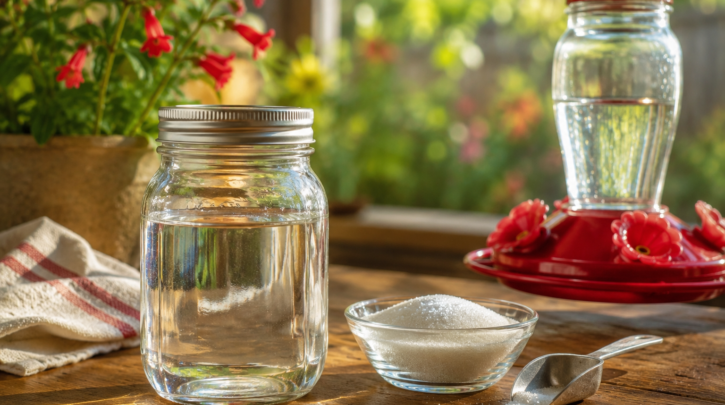

The honest answer to “which nectar should I buy” is usually: don’t buy any. A 1:4 mix of white sugar and water, made at home, matches or beats nearly every commercial hummingbird nectar on cost, freshness, and bird safety. This guide covers why that’s true, and the situations where a store-bought or ready-to-use product is genuinely the more practical choice.
This site participates in affiliate programs. If you buy through a link on this page, we may earn a commission at no extra cost to you. Affiliate disclosure
Why DIY Wins on Cost and Freshness
A bag of white sugar costs a fraction of what commercial nectar concentrate runs per ounce, and because you’re mixing small batches as needed, the nectar going into the feeder is always fresh rather than sitting on a shelf. There’s also no ambiguity about ingredients — it’s sugar and water, full stop. See our feeding guide for the exact ratio and mixing instructions.
What to Check If You Do Buy Nectar
If convenience wins out — traveling, a large number of feeders, or simply not wanting to mix batches — look for a plain, dye-free concentrate or powder listing sucrose as the primary ingredient, the same sugar type found in flower nectar and in a homemade mix. Skip anything dyed red; it offers the birds nothing and adds an ingredient with no proven benefit. Ready-to-use liquid costs more per feeder-fill than concentrate or powder, since you’re paying for water that a tap provides for free.
Nectar Additives and Preservatives
Some brands sell nectar preservatives or “nectar defender” additives marketed to slow fermentation between cleanings. These can modestly extend how long nectar stays clear in hot weather, but they’re not a substitute for a regular cleaning schedule — they buy a little time, not an exemption from it. Treat them as a convenience add-on rather than a core purchase.
Monitoring Nectar Levels
Whatever nectar you use, the real risk is a feeder that quietly runs dry or spoils between checks, which matters most during peak summer demand when a feeder can empty faster than expected. A camera feeder like the Birdfy Hum Feeder helps here in a practical way: it logs every visit to your phone, so a sudden drop-off in activity is an early sign the feeder needs a refill or a clean. Its built-in ant moat also keeps crawling insects out of the nectar you just mixed.
Bottom Line
Make your own nectar as the default. Keep a bag of sugar near the kitchen sink and mixing becomes a two-minute task rather than a shopping-list item, and you’ll never wonder what’s actually in the mix going into a feeder that hummingbirds depend on.
Batch-Mixing and Storage
Making a larger batch and storing the surplus in the refrigerator is the easiest way to keep DIY nectar as convenient as a store-bought bottle. A sealed jar of premixed 1:4 nectar keeps for roughly one to two weeks refrigerated, though it’s worth giving it a smell and visual check before each refill — if it looks or smells off before that window, discard it rather than using it. Bringing refrigerated nectar to room temperature before filling a feeder helps birds take to it immediately rather than being deterred by cold liquid.
Why Red Dye Persists in the Market Despite the Warnings
Dyed nectar is still sold widely, mostly because older marketing built the association between red color and hummingbird attraction, and some buyers assume redder means more effective. In practice, the feeder’s own red parts do that visual work, and the dye adds an unnecessary ingredient with no upside. Most major wildlife and ornithological organizations have recommended against dyed nectar for years, and the trend among newer product lines is clearly moving toward dye-free formulas.
What About Oriole Nectar
Orioles also feed on sugar water, but at a different, often stronger concentration and from feeders with larger ports sized for a bigger bill. Hummingbird nectar and oriole nectar are not interchangeable products despite looking similar on a shelf, and using an oriole feeder’s stronger mix in a hummingbird feeder isn’t recommended. If both species visit your yard, running separate feeders with their respective ratios is the more reliable approach.
A Simple Rule of Thumb
If a nectar product’s ingredient list is longer than “sugar” — or in the ready-to-use case, “sugar and water” — it’s worth asking what the extra ingredients are actually doing. Preservatives that genuinely slow spoilage are defensible; dyes, flavorings, and anything not found in real flower nectar are not adding value for the bird. That single filter cuts through most of the marketing noise on a pet-store nectar aisle faster than reading every label in detail.
When in doubt, the two-minute homemade batch remains the simplest answer for most backyards — it’s cheaper, fresher, and removes the guesswork entirely.