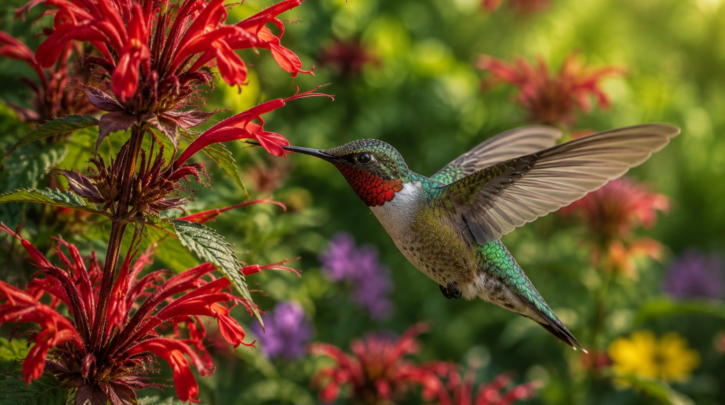

A feeder alone brings hummingbirds in, but the right flowers are what keep them coming back and give them the natural nectar and insects a feeder can’t provide. Hummingbirds key in on shape and color rather than scent, which narrows the useful plant list considerably: tubular flowers in red, orange, or pink outperform almost everything else.
Why Shape and Color Matter More Than Scent
Hummingbirds have a weak sense of smell but excellent color vision, tuned toward the red end of the spectrum where many pollinating insects see poorly — one theory for why so many hummingbird-pollinated flowers evolved bright red and orange coloring in the first place. Tubular or trumpet-shaped blooms fit a hummingbird’s long bill and tongue and often exclude bees and other competitors, which is part of why the plant and the bird evolved together so closely in many species.
Reliable Native and Garden Choices
- Bee balm (Monarda) — native across much of the eastern and central US, blooms through summer
- Cardinal flower (Lobelia cardinalis) — deep red, thrives in moist soil near water features
- Salvia — many red and purple varieties, long bloom season, widely available
- Columbine (Aquilegia) — early-season bloomer, useful for feeding birds right after spring migration
- Trumpet honeysuckle (Lonicera sempervirens) — a non-invasive native vine, unlike some ornamental honeysuckles
- Agastache (hummingbird mint) — drought-tolerant, long bloom window, good for hot climates
- Fuchsia — especially productive in hanging baskets and containers for patios and balconies
One Plant to Use With Caution
Trumpet vine (Campsis radicans) is a hummingbird magnet and native to parts of the eastern and southern US, but it spreads aggressively by root runners and is considered invasive well outside its native range. It’s worth planting where it’s native and can be contained, and worth skipping or planting in a large buried container elsewhere.
Native vs. Ornamental
Native plants generally outperform ornamental cultivars for attracting hummingbirds, since local species evolved alongside regional hummingbird populations and often produce more nectar or bloom on a schedule that matches migration timing. A regional native plant nursery or your state extension office’s native plant list is a more reliable source than a big-box garden center’s seasonal selection, which favors whatever looks good on a shelf over what actually feeds local wildlife.
Skip the Pesticides
Pesticides and broad-spectrum herbicides do double damage: they can be directly toxic to hummingbirds in high enough doses, and they wipe out the small insects and spiders that make up a critical part of a hummingbird’s protein intake. A yard that’s pesticide-free supports both halves of the diet described in our feeding guide — nectar from flowers and insects from a healthy, untreated garden.
Containers and Small Spaces
Renters and anyone without garden beds aren’t out of options. Fuchsia, salvia, and many agastache varieties do well in hanging baskets and large containers on a patio or balcony, and a container garden right next to a feeder often concentrates activity in one easily visible spot — useful if you’re also running a camera feeder and want flowers within frame.
Bloom Timing Matters as Much as Species
A yard with a single showy bloom period in June does less for hummingbirds than a more modest planting that stretches color from early spring through fall, since birds need a reliable food source across the entire time they’re present, not just during one peak flowering window. Staggering bloom times -— columbine early, bee balm and salvia through summer, agastache into fall — keeps natural nectar available across the full season rather than concentrated in a few weeks.
Hummingbirds and Hanging Baskets
Hanging baskets deserve a specific mention because they put flowers at a natural hovering height and are easy to reposition near a window or patio for close viewing. Fuchsia in particular is bred almost specifically for this use case, with pendant blooms that hummingbirds can approach and hover at from below, which is their natural feeding posture at tubular flowers in the wild.
Pairing Plants With a Feeder
Positioning a feeder within view of a flower bed rather than off in an isolated corner of the yard tends to concentrate activity where you can actually watch it, since a hummingbird defending a feeding territory around one food source will patrol the flowers nearby as part of the same territory. It also gives a new feeder a head start getting discovered, since birds are already visiting the flowers planted around it before the feeder itself gets added to the rotation.
A well-chosen planting bed does more for hummingbird visits over a full season than nearly any single feeder upgrade.