
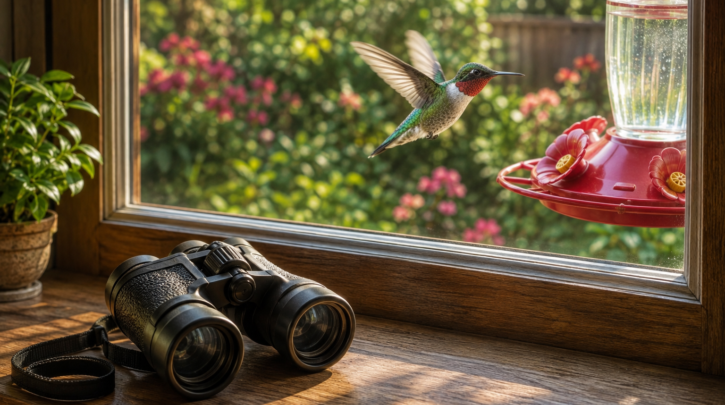

Most binocular buying guides are written for birding in general — a warbler thirty feet up in a tree canopy, a hawk circling overhead. Hummingbirds break almost every assumption in that advice. They’re usually just a few feet away, at a feeder or a flower bed outside a window, and they don’t sit still long enough for a slow focus wheel to catch up.
Instead of organizing this guide by feature category, it’s more useful to build it by budget — because what actually changes as you spend more isn’t magnification, it’s how well a pair keeps up with a bird that’s hovering three feet from your porch rail.
Why Standard Birding Advice Falls Short Here
The one number that matters most for hummingbird-watching barely gets mentioned in general birding guides: minimum close focus distance. A pair optimized for 30-yard woodland sightings often can’t focus at all inside 10 feet, which is nearly useless for a bird that spends most of its visible time hovering at a feeder just outside a window. Add in the fact that hummingbirds dart, reverse, and hover erratically rather than moving in a predictable line — a pattern rooted in the flight mechanics that let them fly backward and stop on a dime — and the gear priorities shift noticeably from what a general-purpose guide would tell you to buy.
Entry-Level: Under $100
At this tier, you’re buying a genuinely usable first pair, not a compromise you’ll regret. The gap between entry-level and mid-range optics has narrowed a lot in recent years, and a well-reviewed budget model from a brand like Celestron or Occer will handle backyard hummingbird viewing better than most people expect.
- What you get: acceptable image clarity in good daylight, lightweight bodies that are easy to grab quickly, and — critically — several current budget models now advertise close focus distances under 6 feet, which didn’t used to be true at this price point
- What you give up: low-light performance drops off noticeably at dawn and dusk, exactly when hummingbirds are often most active feeding before roosting for the night
- Focus wheel feel: budget focus wheels are usually functional but not silky — expect a bit more turning to travel the same focus range compared to pricier models, which can cost you a second or two chasing a bird that’s already moved
This tier makes the most sense if you mainly want a grab-it-off-the-windowsill pair for quick looks at a feeder a few feet away, rather than a bird you’ll be tracking for an extended chase across the yard.
Mid-Range: $100–$300
This is where the real jump happens for hummingbird-watching specifically, and it’s a bigger jump than the price difference alone might suggest. Models like the Vortex Diamondback HD and Nikon Monarch M5 sit in this range and are frequently recommended as the point where optical quality stops feeling like a compromise.
- Close focus distance: several mid-range models focus down to 5 feet or closer, which matters enormously for a bird you might be watching from a porch chair just a few feet from the feeder
- Focus wheel speed: this tier typically adds a faster, smoother focus throw, meaning fewer full turns of the wheel to travel from far focus to close focus — the single biggest practical upgrade for keeping up with a bird that’s hovering, retreating, and hovering again in the space of a few seconds
- Low-light performance: better glass coatings and larger, higher-quality lenses noticeably improve visibility during the dim early-morning and evening hours when hummingbirds are often at their most active
- Weight: still light enough for the quick, casual grab-and-view sessions typical of hummingbird-watching, unlike some larger birding-specific binoculars built for long stationary sits
The Sweet Spot for Most Backyard Birders
For anyone serious about watching hummingbirds regularly but not looking to spend premium money, this tier is genuinely the sweet spot. The combination of a faster focus wheel and a closer minimum focus distance addresses both of the two biggest hummingbird-specific pain points at once, in a way entry-level gear usually can’t.
Premium: $300 and Up
Premium optics from brands like Vortex’s higher-end Viper line, Swarovski, and similar top-tier manufacturers deliver noticeably better glass, coatings, and mechanical smoothness. Whether that translates into a meaningfully better hummingbird-watching experience depends heavily on how you actually use the binoculars.
| What You Gain | How Much It Matters for Hummingbirds |
|---|---|
| Ultra-fast, buttery focus wheel | High — the closest thing to a direct upgrade for tracking erratic hovering |
| Best-in-class low-light glass | Moderate–high, especially valuable at dawn and dusk feeding peaks |
| Superior edge-to-edge image sharpness | Low for close feeder-watching; matters more for distant field birding |
| Rugged, professional-grade build | Low unless the pair sees heavy daily outdoor use |
Where premium optics earn their price for hummingbird-watching specifically is the focus wheel, full stop. A top-tier close-focus wheel can travel from infinity to under 5 feet in a fraction of a turn, which is the single most valuable trait for a bird that changes direction faster than almost anything else you’ll ever point binoculars at. If you’re mainly viewing a single backyard feeder, though, a lot of what premium glass adds — edge sharpness across a wide field, ruggedness for rough field conditions — goes largely unused.
The Two Specs That Matter Most, Side by Side
If you only compare two numbers across models at any budget, make them these:
- Minimum close focus distance — look for 6 feet or less; some hummingbird viewing genuinely happens at 3 to 4 feet, closer than almost any other backyard bird you’d point binoculars at
- Focus wheel throw (how many degrees of turn it takes to travel the full focus range) — a shorter throw means less time spent turning the wheel and more time actually watching a bird that’s already moved on
A Note on Low-Light Performance
Hummingbirds are frequently most active in the hour after sunrise and the hour before sunset, feeding heavily to build the energy reserves they need overnight. Binoculars with larger objective lenses and better glass coatings gather more light during these dimmer windows, which is worth weighing against your budget if most of your viewing happens at those times rather than midday. This is also the same daily rhythm covered in our guide to hummingbird facts, where feeding frequency and daylight are closely tied together.
Do You Even Need Binoculars for a Backyard Feeder?
Worth asking honestly: for a single feeder a few feet from a window, probably not. Hummingbirds are often close enough to identify field marks with the naked eye, and a camera feeder can capture close footage without needing to hold anything up at all. Binoculars earn their place once you’re watching from farther across the yard, trying to confirm a field mark on a bird perched in a tree, or identifying a visiting species that isn’t sitting still long enough for a clear naked-eye look.
Ready to compare current models? Browse binoculars at B&H Photo for the full range of brands mentioned here, from entry-level Celestron to premium Swarovski.
This site participates in affiliate programs. If you buy through a link on this page, we may earn a commission at no extra cost to you.