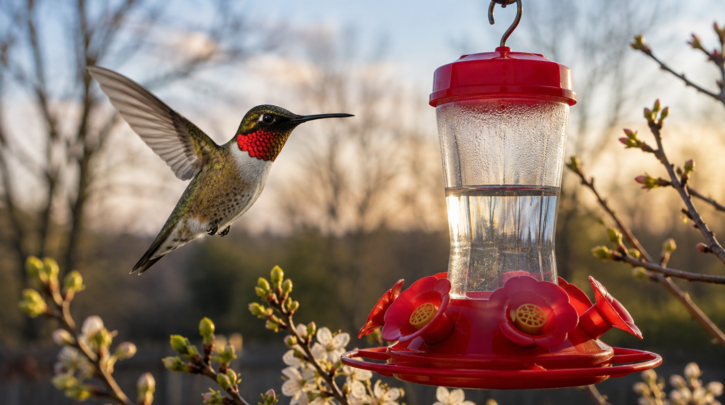

Spring is arrival season, and the practical work is almost entirely about timing: getting a clean feeder up before the first birds show up rather than scrambling once they’ve already arrived, and understanding that early spring cold snaps are one of the genuinely riskier stretches in a hummingbird’s year.
When to Expect the First Arrivals
Timing follows a rough south-to-north wave. Gulf Coast states typically see the first ruby-throated hummingbirds in March, the mid-Atlantic and Midwest in April, and New England and southern Canada by mid-to-late May. Western species follow broadly similar regional patterns adjusted for range. Checking recent regional sightings on eBird a week or two ahead of the typical date for your area is more reliable than working from a fixed calendar date alone, since timing shifts somewhat year to year; see our migration guide for how that timing actually works.
Get the Feeder Up Early
Hanging a clean, filled feeder about one to two weeks before the expected first sighting for your area gives arriving birds — especially ones who haven’t scouted your yard before — a resource in place from day one, rather than catching them mid-search after a long migration flight. There’s no downside to being early; an unused feeder for a week or two isn’t wasted effort, and see our feeding guide for the 1:4 nectar ratio if you’re mixing a fresh batch after winter storage.
Clean Winter Storage Off the Feeder First
A feeder that’s been in storage over winter often needs a real cleaning before use, not just a rinse — residue from the last fill of the previous season can harbor mold even after months of being empty. A full wash with hot water and, if needed, a diluted vinegar solution, as covered in our feeder guide, is worth doing before the first spring fill rather than assuming an empty feeder is automatically a clean one.
Males Arrive First
In most species, males migrate north ahead of females by roughly a week or two, arriving early to stake out and defend a feeding and breeding territory before females show up. This means the first hummingbirds seen at a spring feeder are disproportionately likely to be males; see our male vs female guide for how to tell early on.
Watch for Late Cold Snaps
An unseasonable cold spell in early spring is a genuine hazard for newly arrived birds, since natural nectar sources may not have bloomed yet and a sudden temperature drop increases energy demand right when food is scarcest. Keeping a feeder reliably stocked through an unexpected cold snap — bringing it inside overnight if temperatures approach freezing and putting it back out at first light — can matter for birds with genuinely limited food options that early in the season.
Plant for the Season Ahead
Spring is also the right time to get early-blooming plants like columbine established, since they’ll be ready to support birds in the weeks right after arrival when a feeder alone may not be doing all the work. See our plant guide for species that bloom early enough to matter for this specific window.
Nesting Begins Soon After
Females typically begin nest-building within a few weeks of arrival once territories are established and mating has occurred; see our nesting guide for what that construction looks like and how to spot early signs of it in your own yard.
First-Year Birds Returning for the First Time
Spring also brings back young birds hatched the previous year, now making their first full round-trip migration on their own rather than following an adult. These first-time migrants sometimes arrive slightly later than experienced adults and may take a little longer to settle into a stable territory, since they’re navigating and route-finding without the benefit of a previous year’s experience.
A Simple Spring Checklist
- Clean and inspect the feeder before the first fill of the season
- Hang it 1-2 weeks ahead of the typical first-sighting date for your area
- Mix a fresh 1:4 nectar batch rather than using anything left from last fall
- Check regional eBird reports for early arrivals nearby
- Have a plan for bringing the feeder in during any late cold snap
Regional Variation Within Spring
Spring in the Gulf Coast states and spring in southern Canada aren’t remotely the same season by the time arrivals actually happen — a Texas backyard might see its first birds in early March while a Minnesota yard is still weeks from its own arrival window in May. Rather than treating spring as one calendar block, it’s more useful to think of it as a moving wave that reaches each region at its own pace, which is exactly why checking recent local sightings beats working from a single nationwide date.