
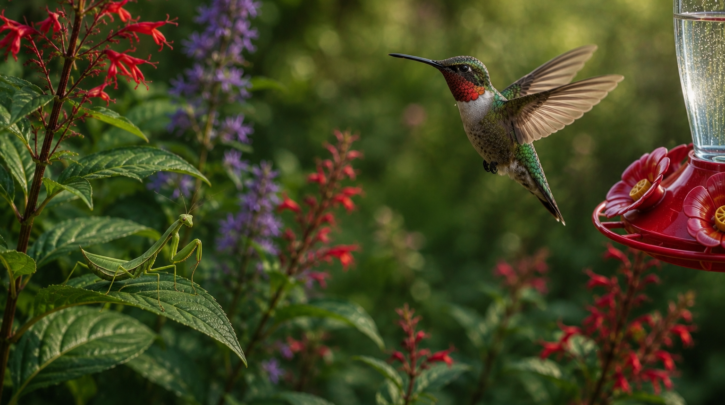

Hummingbirds are small and fast enough that most predators simply can’t catch them in open flight, which pushes their real threats toward ambush rather than pursuit — praying mantises waiting motionless at a feeder, spiderwebs strung across a flight path, and nest predators that go after eggs and chicks rather than adult birds.
Praying Mantises
This is one of the more surprising entries on the list, but it’s well documented: praying mantises large enough to do it will ambush and catch hummingbirds at feeders, striking as the bird hovers to feed. It’s an occasional rather than common event, but it’s frequent enough that some birders relocate large mantises found near a feeder rather than leaving them in place through the season.
Orb-Weaver Spiders
Large orb-weaver spiderwebs can occasionally trap and kill a hummingbird that flies into them, particularly young or inexperienced birds. There’s a genuine irony here, since hummingbirds also rely on spider silk as a key nest-building material, discussed in our nesting guide — the same webs that provide construction material for one generation can pose a real risk to another bird passing through.
Outdoor Cats
Domestic and feral cats are a serious threat to small birds broadly, and hummingbirds are no exception, particularly around feeders and low perches where a cat can approach unseen. Keeping feeders and flower plantings well away from dense ground cover a cat could stalk from, and keeping pet cats indoors or supervised outdoors, meaningfully reduces this risk.
Larger Birds
Sharp-shinned hawks and other small, agile raptors occasionally take hummingbirds, and larger songbirds like jays are a more consistent threat to nests specifically, raiding eggs and young chicks rather than pursuing adult birds in flight. See our eggs guide and baby hummingbird guide for how nest siting and camouflage work to reduce this exposure.
Snakes and Nest Predators
Tree-climbing snakes, along with squirrels in some regions, are among the more significant threats to eggs and nestlings specifically, since a stationary nest is a far easier target than an adult bird in flight. This is part of why nest placement on thin, hard-to-climb outer branches matters as much as camouflage — both raise the difficulty for a predator that has to reach the nest without the supporting branch giving way.
Reducing Predator Risk Around Your Feeder
- Keep feeders a few feet from dense shrubs or ground cover that could hide a stalking cat
- Check for large spiderwebs or mantises near feeders periodically during peak season
- Avoid placing feeders directly beneath overhanging branches where a raptor could perch and watch
- Keep pet cats indoors, or supervised, especially during peak feeding hours
Frogs and Bullfrogs
Less commonly, large frogs and bullfrogs positioned near a water feature or pond have been documented catching hummingbirds that come too close while drinking or bathing. This is a rare event compared to the risks above, but it’s a reasonable argument for positioning a water mister or shallow bath away from a pond’s edge rather than directly beside standing water with resident frogs.
Why Documenting Sightings Helps
A camera feeder that captures a predation attempt or a close call isn’t just dramatic footage — it’s useful information about what’s actually present and active in a specific yard, which can inform where to reposition a feeder or whether a particular mantis or web needs to be relocated. Most predator encounters happen too fast to observe directly, so a continuous camera record often reveals risks that would otherwise go unnoticed entirely.
Predation Risk During Nesting vs. Migration
Adult hummingbirds face the most predation risk from ambush predators like mantises and spiders while actively feeding, while eggs and chicks face the greatest exposure from climbing and nest-raiding predators during the weeks they’re confined to a fixed nest location; see our nesting guide for how nest placement is specifically built around minimizing that second category of risk.
The Bottom Line on Predator Risk
None of these threats should discourage feeding hummingbirds — for a species this small, some predation risk is unavoidable regardless of human intervention, and a thoughtfully placed, well-maintained feeder does far more good than the modest added risk of drawing birds into one visible spot.
A little situational awareness — noticing a new web, an unusually still mantis, or a cat that’s started lingering nearby — covers nearly everything a backyard birder can realistically do about it.
The upside is that most of these predators only succeed occasionally, which is exactly why hummingbird populations remain healthy across most of their range despite the list of threats above.