
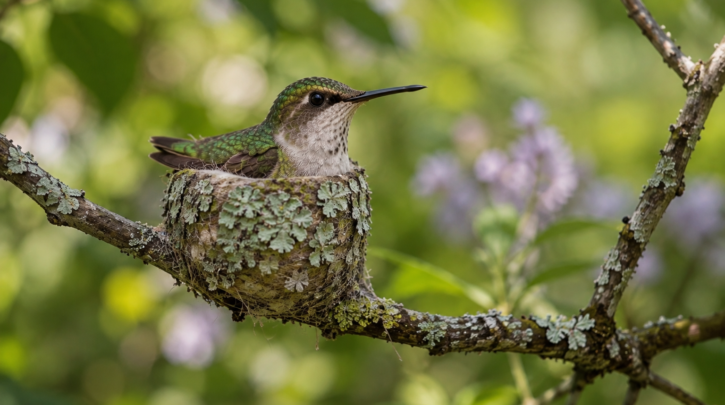

A hummingbird nest is one of the smallest and most easily overlooked structures in a backyard — often no bigger than a golf ball, saddled on a thin branch and camouflaged well enough to pass for a knot of bark. Females build entirely alone, using a small set of materials that let the nest physically stretch as chicks grow inside it. This guide covers how that construction works, where to actually look, and how many broods a female raises in a season.
Who Builds the Nest
Nest construction is entirely the female’s job. Male hummingbirds don’t pair up, help gather material, or defend the nest site — their role ends after mating. This lines up with the broader pattern covered in our male vs female guide: males invest in bright plumage and display to attract mates, while females handle every stage of raising young alone, including a nest built to be discreet rather than showy.
Materials and the Spider Silk Trick
The core building material is plant down — soft fibers from dandelion seed heads, cattail fluff, or thistle — packed into a small cup shape. What makes the nest genuinely clever is spider silk woven through that down: it binds the structure together while staying elastic, which lets the nest physically stretch wider as the chicks inside grow from bumblebee-sized hatchlings to nearly full-grown birds. The outside is finished with flakes of lichen and moss pressed on with more silk, which breaks up the nest’s outline against bark and makes it remarkably hard to spot even a few feet away.
Where Nests Are Built
Most nests are saddled on top of a thin, often downward-sloping branch rather than tucked into a fork, typically anywhere from 10 to 40 feet up depending on species and available cover. A location with overhead leaf cover is preferred, since it offers some protection from rain and direct sun without blocking the female’s sightlines to approach and leave quickly. Deciduous trees, shrubs, and even sturdy vines all get used; the common thread is a thin branch that would make a heavier nest impractical, which is part of why hummingbird nests stay so small and light.
How Long Building Takes
A female typically completes a nest in about 6 to 10 days, though she may continue reinforcing it with more silk and down even after laying begins. Building slows down considerably once eggs are present, since she’s now splitting time between incubating and any final touch-ups. Nest-building speed can also depend on weather and material availability — a female with easy access to spider webs and downy plants nearby finishes noticeably faster than one working a sparser territory.
Multiple Broods Per Season
Many hummingbird species raise two broods in a single season, and some manage three in areas with a long enough warm season. A female may reuse the same nest for a second brood after the first has fledged, rebuild directly on top of the old structure, or start an entirely new nest nearby. Reusing or building on an old nest saves time and material, since the base structure and camouflage are already in place — it just needs fresh lining and reinforcement before the next clutch of eggs goes in.
Finding a Nest Without Disturbing It
If you suspect a nest nearby, the best approach is patience rather than active searching — watch where a female repeatedly disappears to and from over a few visits, since that flight path narrows the search area far faster than scanning branches at random. Once located, keep visits brief and from a distance; repeated close approaches can cause a female to abandon a nest, especially early in construction or incubation. See our eggs guide for what to expect once a clutch is laid.
Nest Height and Predator Avoidance
Height and placement aren’t arbitrary — nests saddled on thin outer branches are harder for climbing predators like snakes and squirrels to reach without the branch bending or breaking, which gives a sitting female extra warning time. See our predators guide for the full list of threats a nest and its occupants actually face through the season.
Reusing a Nest Site Across Years
Some females return to the same territory, and occasionally the exact same tree or even the same nest structure, in consecutive years, rebuilding on top of a weathered previous nest rather than starting from scratch nearby. This isn’t universal — plenty of females build entirely new nests each season — but site fidelity does show up often enough in banding studies that a nest found one year is worth checking again the next, particularly if the surrounding habitat hasn’t changed.
Regional and Species Differences
Nest height, material choice, and timing shift somewhat by species and region. Anna’s hummingbirds along the Pacific Coast sometimes begin nesting as early as December or January, well ahead of most other North American species, taking advantage of a mild climate and early-blooming plants. Species nesting at higher elevations, like broad-tailed hummingbirds in the Rockies, generally start later and compress breeding into a shorter window that matches a shorter mountain summer.
Spotting a Nest in Your Own Yard
A hummingbird nest is easy to walk past dozens of times without noticing, since the lichen camouflage is genuinely effective and the nest itself sits on a thin branch rather than in an obvious fork or crook. The most reliable tell isn’t the nest itself but repeated female activity — a hummingbird making frequent, short flights to the same general area of a tree, especially if she’s carrying nesting material or returning empty-billed on a tight loop, is worth watching quietly from a distance rather than approaching the tree directly to search branch by branch.