
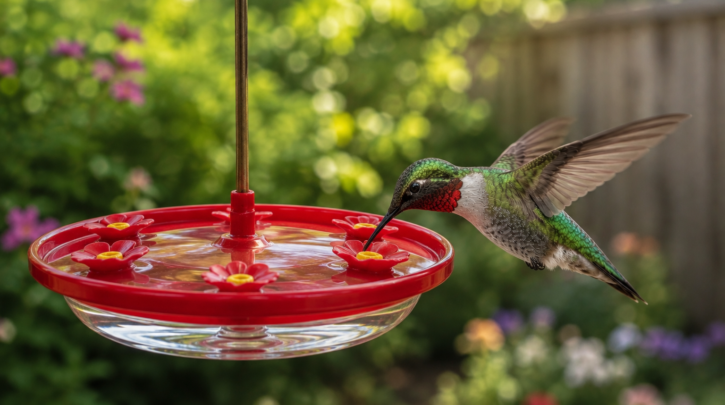

The single biggest factor in a good hummingbird feeder isn’t capacity or looks — it’s how easy the thing is to take apart and clean, because a feeder you dread cleaning is a feeder that eventually grows mold. Beyond that, the choice comes down to saucer versus bottle style, how many ports you actually need, and whether a camera feeder is worth the jump in price.
Saucer vs. Bottle Feeders
Saucer (or dish) feeders hold nectar in a shallow reservoir below the feeding ports, which means they rarely leak or drip and are simple to fully disassemble for cleaning. Bottle-style feeders, with an inverted reservoir above the ports, typically hold more nectar and need refilling less often, but they’re more prone to drips as air pressure shifts with temperature, and drips attract ants and wasps. For most backyards, a saucer feeder is the lower-maintenance choice; bottle feeders make more sense if you’re feeding a large number of birds and don’t want to refill daily.
Features Worth Paying For
- Built-in ant moat — a small reservoir on the hanger that blocks crawling ants without pesticides
- Bee and wasp guards — small cages over each port that let hummingbird bills through but block wider insect mouths
- Wide-mouth reservoirs — makes hand-washing and brush access dramatically faster than narrow-necked bottles
- No dyed-red plastic requirement — feeders with molded-in red accents attract birds without needing dyed nectar
Camera Feeders: Worth the Upgrade?
Smart feeders with a built-in camera and AI species recognition, like the Birdfy Hum Feeder, log a photo or short clip every time a bird visits and tag the species automatically. That turns a feeder into a genuine identification and record-keeping tool, which is especially useful in regions where several similar-looking species overlap. They cost significantly more than a basic saucer feeder, but for anyone who’s asked “what was that?” about a blur at the feeder, it solves the problem outright.
Our pick in this category is the Birdfy Hum Feeder. Its side-angled ports catch hummingbirds in profile, the angle that shows the field marks you need for an ID, and it has a built-in ant moat, so it checks the most important box from the features list above as well.
If you are weighing camera feeders more closely, our hummingbird camera guide covers storage plans, placement for the clearest footage, and how a feeder camera compares with a DSLR.
How Many Ports Do You Need
A single 4-port saucer feeder comfortably serves most backyards with light to moderate hummingbird traffic. If you’re seeing frequent chasing and territorial disputes at one feeder, the fix usually isn’t more ports on the same feeder — it’s a second feeder placed out of sight from the first, since hummingbirds are territorial enough that ports on a single unit don’t fully solve crowding.
Placement Tips
Hang feeders in partial shade where possible; direct sun accelerates fermentation and shortens how long nectar stays good. Keep feeders at least a few feet from windows, or right up against the glass with a decal, to reduce collision risk — the danger zone is the middle distance where a startled bird has enough room to build speed before impact. And place feeders somewhere you’ll actually see them daily, since regular observation is how you catch a cloudy reservoir or an empty feeder before it becomes a problem.
Glass vs. Plastic
Glass reservoirs resist staining and scratching far better than plastic over years of use, and they don’t develop the cloudy, hard-to-clean surface that plastic feeders eventually get. Plastic is lighter, cheaper, and more shatter-resistant, which matters if the feeder hangs somewhere it might get knocked around by wind or wildlife. Neither material affects how well a feeder attracts birds; it’s purely a durability and maintenance tradeoff.
How Many Feeders Should You Have
One feeder is enough to start, but adding a second feeder positioned out of sight from the first — around a corner of the house or on the opposite side of the yard — noticeably reduces the territorial chasing that keeps other birds away from a single, heavily guarded feeder. This matters most in regions with multiple overlapping species or high population density during migration, where a lone dominant male can otherwise monopolize the only nectar source in the yard.
Setting Up a New Feeder
New feeders can take a few days to a couple of weeks to get discovered, especially outside peak migration windows. Hanging it near existing flowers, at a height around 5 to 6 feet, and keeping it filled and clean during that waiting period gives it the best odds of getting noticed and added to a local bird’s regular feeding route once it does.