
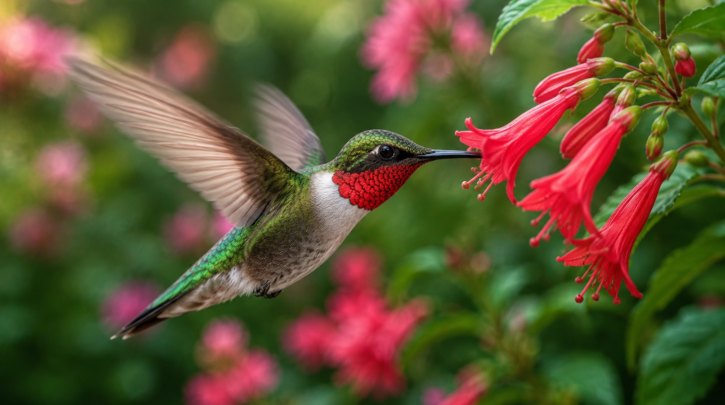

Hummingbirds do things no other bird can, and most of it comes down to a body built entirely around extreme, sustained energy use. Below are 25 facts grouped by flight, physiology, behavior, and migration — the kind of details that hold up to a second look rather than the exaggerated numbers that circulate online.
Flight
- Hummingbirds are the only birds that can fly backwards, thanks to a figure-eight wing motion and a shoulder joint that rotates nearly 180 degrees.
- Most species beat their wings 50 to 80 times per second in normal flight; during courtship dives, some exceed 200 beats per second.
- They can also hover in place indefinitely and fly straight up, down, or briefly upside-down — flight modes no other bird combines.
- Top flight speeds reach roughly 30 miles per hour in level flight, with courtship dives clocked well above that for the Anna’s hummingbird.
- A hummingbird’s brain processes visual information fast enough to navigate cluttered branches and flower clusters at full speed without collisions.
Body & Physiology
- The bee hummingbird of Cuba is the smallest bird on Earth, at about 2 inches long and roughly 2 grams — lighter than a dime.
- A hummingbird’s heart can beat over 1,000 times per minute during active flight, and makes up a larger share of its body weight than in any other bird.
- Gorget color isn’t pigment. It comes from microscopic feather structures that scatter light, which is why the same throat patch can flash bright red one moment and look black the next.
- Their tongues extend roughly twice the length of the bill and use an elastic, fringed structure to lap up nectar at around 10 to 15 licks per second.
- Hummingbirds have very few taste buds and can’t taste salt, but they’re highly sensitive to sugar concentration, which is why nectar ratio matters.
Behavior
- Every night, hummingbirds enter torpor, a controlled, hibernation-like state where metabolic rate and body temperature drop sharply to conserve energy.
- Despite their delicate look, hummingbirds are fiercely territorial and will aggressively chase off birds many times their size, including hawks.
- Males take no part in nest-building, incubation, or feeding chicks — all parental care falls to the female.
- A hummingbird needs to eat roughly its own body weight in nectar and insects each day just to maintain its metabolism.
- Insects and spiders, not nectar, provide the protein hummingbirds need, especially for females producing eggs and feeding nestlings.
Migration
- Ruby-throated hummingbirds cross roughly 500 miles of the Gulf of Mexico in a single nonstop overwater flight during migration.
- Rufous hummingbirds make one of the longest migrations relative to body size of any bird on Earth, traveling from Alaska to central Mexico and back.
- Before migrating, hummingbirds can put on 25 to 40 percent of their body weight in fat reserves to fuel the trip.
- See the full migration guide for arrival and departure timing by region.
Diversity & Range
- Roughly 360 hummingbird species exist worldwide, and every single one is native only to the Americas.
- Only about 15 to 20 species regularly breed in the United States and Canada; the rest are concentrated in Central and South America.
- Ecuador alone hosts well over 130 hummingbird species, more than any other country, thanks to its range of elevations and habitats.
- See our identification guide for how to sort out the species most likely to visit a North American backyard.
Bringing Them to Your Yard
Nearly all of these traits point to the same practical takeaway: hummingbirds run on a tight energy budget, so a reliable nectar source and a clean feeder do more to attract and keep them around than almost anything else. A camera feeder adds a fun layer on top of that — turning nightly torpor, feeding visits, and territorial standoffs into something you can actually watch and review.
See which visitors are actually stopping by Check out camera feeders
Common Myths, Corrected
A few claims about hummingbirds circulate widely but don’t hold up. They don’t migrate by riding on the backs of geese — that one’s pure folklore, and hummingbirds make their migration entirely under their own power. Feeding hummingbirds sugar water doesn’t stop them from migrating on schedule either; migration timing is driven by day length, not food availability, so a feeder left up too late won’t trap a bird into staying past a safe departure window. And while they do have famously fast heartbeats, the often-repeated “1,200 beats per minute at all times” figure only applies during active flight — resting and torpid heart rates are dramatically lower.