
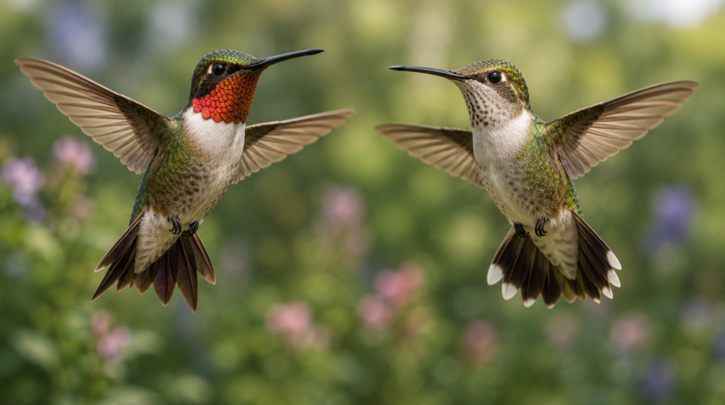

In most North American hummingbird species, males and females look different enough that a birder unfamiliar with the pattern can mistake them for two different species entirely. The short version: males carry the flashy iridescent throat patch (gorget) that hummingbirds are known for, and females almost always don’t. But that single rule leaves a lot of edge cases, especially with juvenile males, so it’s worth knowing the full set of traits.
This site participates in affiliate programs. If you buy through a link on this page, we may earn a commission at no extra cost to you. Affiliate disclosure
The Gorget Rule — and Its Exceptions
Adult males of nearly every North American species have a brightly colored, iridescent throat patch: red on ruby-throated, purple-black on black-chinned, rose-pink on Anna’s. Adult females lack this entirely and instead show a plain or lightly streaked whitish throat. The exception that trips people up is young males in their first year, which look almost exactly like females until they molt into adult plumage — see the lifespan guide for how that first-year timeline plays out.
Size and Tail Differences
Females of most species are very slightly larger and heavier than males, which makes sense given they alone build the nest and incubate the eggs. The more useful visual cue is the tail: male ruby-throated and black-chinned hummingbirds have a more deeply notched, forked tail, while females show a rounder tail with white tips on the outer feathers. In species like rufous, males have a more pointed, rufous-heavy tail compared to the female’s broader, more banded tail.
Behavior Differences at the Feeder
Males and females also behave differently around feeders and flowers. Males tend to be territorial, perching near a preferred feeder and chasing off other hummingbirds, sometimes including females. Females spend more time actually feeding rather than defending, since during nesting season they need significantly more calories to support egg production and, later, to feed chicks. A hummingbird that’s aggressively guarding a feeder rather than steadily drinking from it is very likely a male.
A camera feeder like the Birdfy Hum Feeder makes these patterns much easier to confirm, since you can replay visits and compare how long each bird actually spends drinking.
Juvenile Males Look Like Females
This is the biggest identification trap in the whole topic. Young males hatch without any gorget color and closely resemble adult females for their first few months, sometimes showing only a faint spot or two of adult color as the molt begins. By the time they migrate south for their first winter, most young males still look mostly female. Full adult gorget color typically doesn’t come in until the following spring, so a “female” hummingbird seen in late summer or fall is sometimes actually a juvenile male.
Species-by-Species Notes
The gorget-and-tail rule holds up consistently across ruby-throated, black-chinned, Anna’s, and Costa’s hummingbirds. Rufous and Allen’s are trickier because females and juveniles of both species are nearly identical to each other, and males can show variable amounts of throat color depending on age. Calliope males have a distinctive streaked, wine-red gorget rather than a solid patch, which actually makes them easier to sex than most other species once you know to look for the streaking pattern instead of a solid color block.
Why the Difference Exists
The visual gap between the sexes comes down to hummingbird mating behavior. Males don’t pair up, build nests, or help raise young — their entire reproductive strategy is attracting as many mates as possible through display and color, which favors bright, conspicuous plumage even at the cost of being more visible to predators. Females need the opposite: camouflage that keeps a sitting bird and a nest hidden from jays, snakes, and other nest predators. See our nesting guide for how that plays out in nest-site choice and construction.
What About Anna’s and Costa’s Females?
Anna’s and Costa’s females are slightly easier to sex than rufous or Allen’s because males of both species have unmistakable, extensive gorgets — Anna’s rose-pink hood covers the crown as well as the throat, and Costa’s violet gorget flares out past the sides of the head like a mustache. Females of both species show only a small central throat spot at most, sometimes none at all, which makes the male/female split fairly reliable even for a casual glance at a feeder rather than a close, patient look.
Quick Field Checklist
- Bright, solid throat color — male
- Plain or lightly spotted whitish throat — female or juvenile male
- Aggressively guarding the feeder rather than feeding — usually male
- Deeply forked tail with little white — typically male
- Rounder tail with white-tipped outer feathers — typically female
Why This Matters for Your Feeder Records
If you’re logging visitors with a camera feeder or a simple notebook, sexing the birds you see — not just counting species — gives a much clearer picture of what’s actually happening in your yard. A pair of territorial males squabbling over one feeder looks very different from a female making regular visits to fuel up for egg-laying, and the second pattern is a good sign an active nest is nearby. See our eggs guide and baby hummingbird guide for what typically follows.