
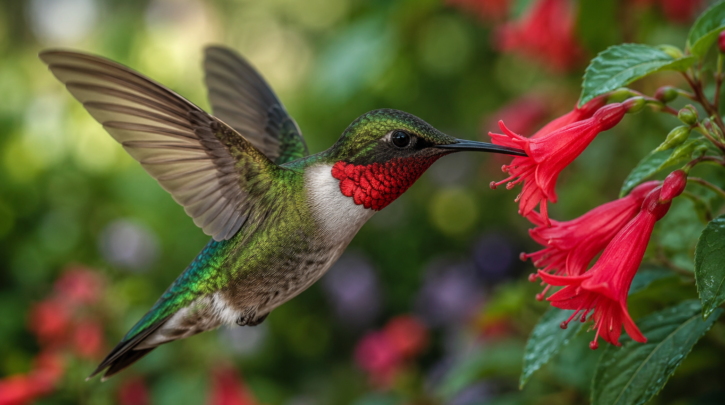

About 360 hummingbird species exist worldwide, but only around 15 to 20 regularly breed in the United States and Canada, and most yards will only ever host two or three of them depending on region and season. That narrows the identification problem considerably. Instead of working through every hummingbird ever recorded, the fastest path to a confident ID is range, season, and a handful of shortcuts: throat color, body size, tail shape, and behavior at the feeder.
This guide covers the species you’re actually likely to see, the traits that hold up in ordinary backyard lighting, and the identification traps — mainly female and juvenile birds — that trip up even experienced birders.
Start With Range and Season
East of the Mississippi, identification is almost trivial: the ruby-throated hummingbird is the only species that breeds there, so any hummingbird at an eastern feeder between April and October is very likely a ruby-throated. West of the Rockies the picture opens up — Anna’s, rufous, black-chinned, Costa’s, broad-tailed, calliope, and Allen’s all overlap depending on state, elevation, and time of year. Checking recent sightings for your county on a site like eBird before assuming a species is often faster than working through field marks, since it immediately rules out birds that simply aren’t present in your area that month. See our migration guide for typical arrival and departure windows by region.
Ruby-Throated Hummingbird
The ruby-throated hummingbird (Archilochus colubris) is the default eastern species — emerald-green back, pale gray-white underside, and on adult males a brilliant red throat patch (gorget) that can look black in low light. Females and juveniles lack the red throat entirely and show a plain whitish throat with light streaking, which is the single biggest source of eastern misidentification: a gorget-less bird gets reported as a “different” species when it’s simply a female or young ruby-throated. Body length runs about 3 to 3.5 inches, tiny even by hummingbird standards.
Western Species at a Glance
Anna’s hummingbird is the only species that overwinters in numbers along the Pacific Coast, with males showing a rose-pink gorget that extends up over the crown — unusual among North American species. Rufous hummingbirds are compact and orange-backed, aggressive at feeders, and famous for the longest migration relative to body size of any bird. Black-chinned hummingbirds look almost identical to ruby-throated but replace the red gorget with purple-black, visible only at the right angle. Costa’s, broad-tailed, calliope, and Allen’s round out the common western set:
- Anna’s — rose-pink gorget over the crown, year-round on the Pacific Coast
- Rufous — orange back, feisty at feeders, longest relative migration of any bird
- Black-chinned — ruby-throated look-alike with a purple-black gorget
- Costa’s — deep purple gorget that flares past the head, desert Southwest
- Broad-tailed — high-elevation Rockies; male wings produce a metallic trill in flight
- Calliope — the smallest breeding bird in the US, streaked magenta gorget
- Allen’s — near-identical to rufous, restricted to a narrow coastal range
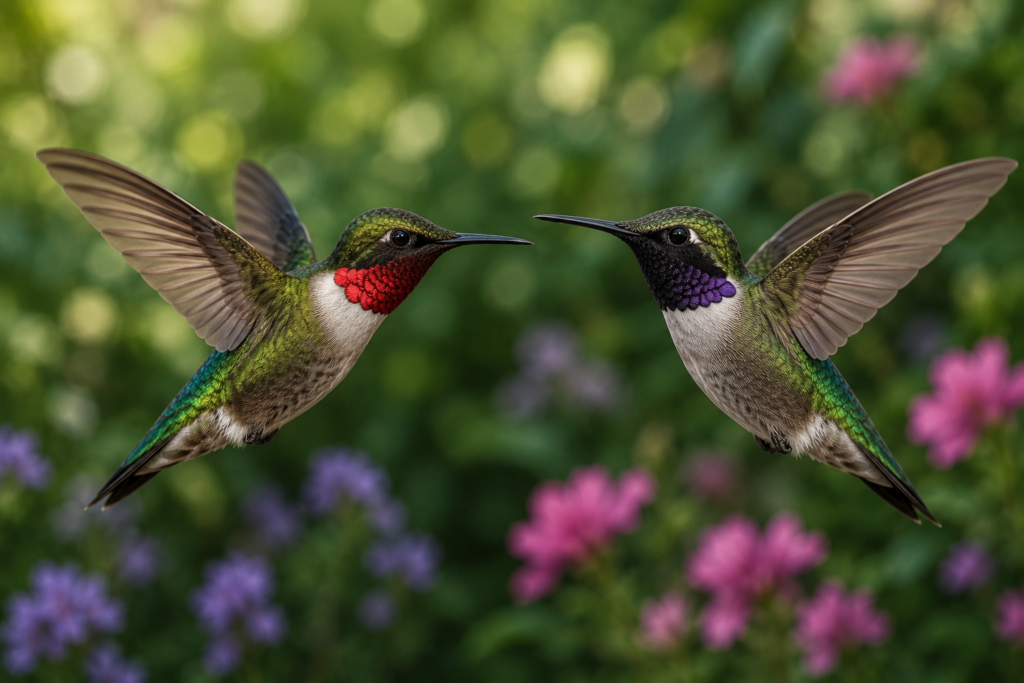
Gorget Color: The Fastest Clue — and Its Catch
A male hummingbird’s throat patch is the fastest ID clue when it’s visible, but the catch is that it isn’t pigment — gorget color comes from microscopic feather structures that scatter light, so the same bird can flash brilliant red one second and look flat black the next depending on the angle to the sun. Don’t rule out a species because the throat “wasn’t the right color” on a single look; wait for the bird to turn, or lean on other traits like body proportions and behavior instead of one glimpse of iridescence.
Size, Shape, and Tail
When color is ambiguous, shape holds up better. Tail length and notch depth vary by species and are visible even in silhouette: ruby-throated and black-chinned show slightly forked tails, while rufous and Allen’s show more rounded, rufous-edged tails. Bill length matters too — most North American species have straight bills around 15 to 20mm, so a noticeably longer or curved bill in the Southwest suggests a rarer visitor. Overall bulk is a decent quick filter: calliope is visibly the smallest North American species, while broad-billed and magnificent hummingbirds, both Southwest specialties, run noticeably larger.
Male vs Female Complicates Nearly Every Sighting
Because females and juveniles of most species lack a colored gorget and share a similar green-and-white palette, a large share of “mystery” hummingbirds at feeders are simply females rather than a different species. See our full male vs female guide for the traits — tail shape, throat streaking, and size — that actually separate the sexes within a single species.
Confirm It With a Camera Feeder
The most reliable way to nail down a tricky ID without chasing the bird with binoculars is a feeder-mounted camera with built-in species recognition. Models like the Birdfy Hum Feeder log AI-tagged clips of every visit, which turns a five-second glimpse into a photo you can actually study — and over a season it builds a real record of which species are using your yard and when. See our best hummingbird camera guide for picks.
Want photographic proof of every visitor? See the Birdfy Hum Feeder
Common Identification Mistakes
Three mix-ups come up constantly. The first is mistaking a female for a distinct species, covered above. The second is mistaking a hummingbird moth — several sphinx moth species hover at flowers and look startlingly bird-like at a glance — for an actual hummingbird. The third is assuming a young male without his adult gorget yet is a female, when he simply hasn’t molted into full color. None of these are hard to sort out once you know to look for them, but they explain a lot of the “I saw a species that doesn’t belong here” reports birders get.